A Guide to Engine Warning Lights and What to Do
A warning light appearing on the dashboard just before the school run, commute or delivery round is never convenient. This guide to engine warning lights explains what the light is telling you, what action to take and why a proper diagnostic check is often the quickest way to protect your vehicle and your budget.
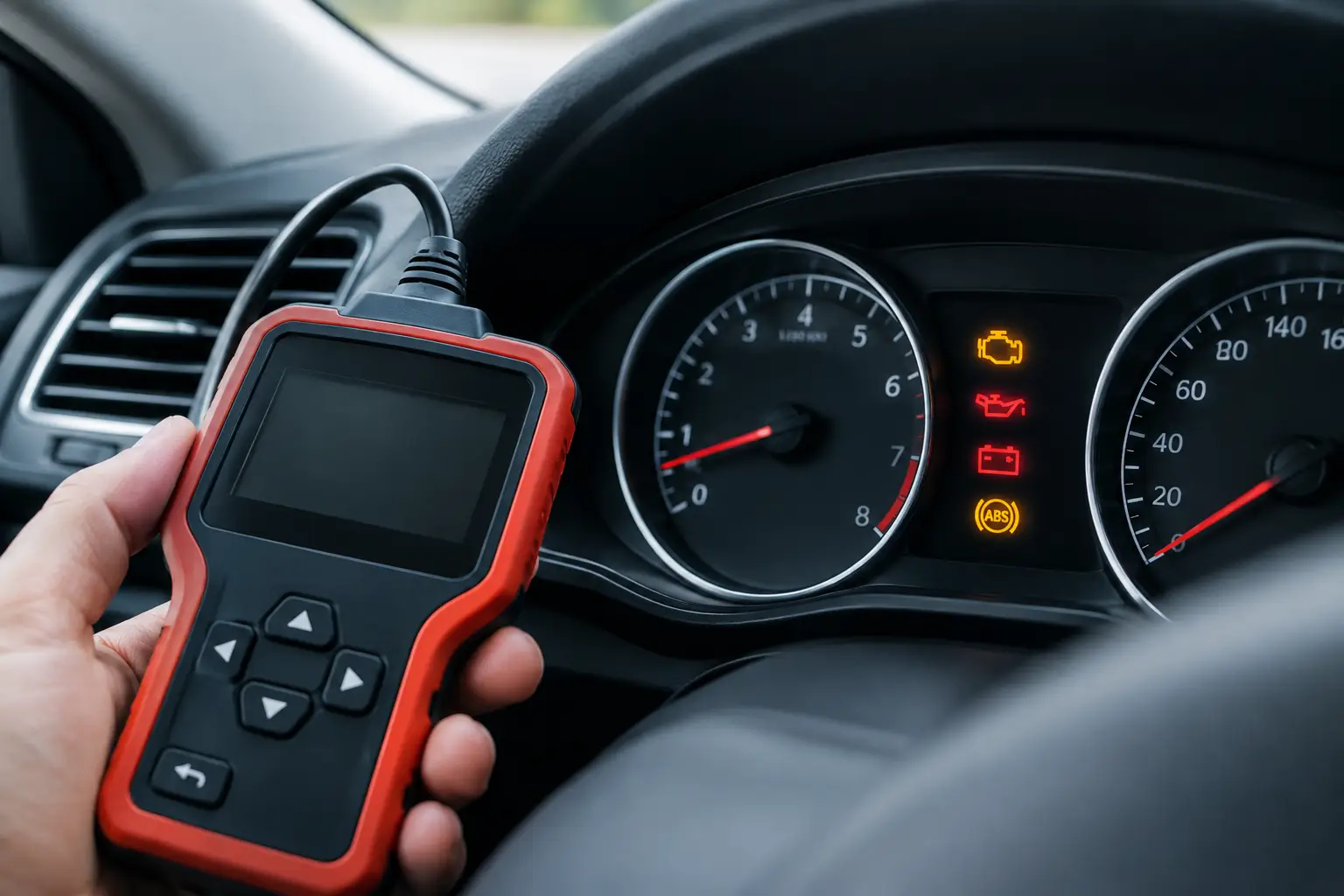
The light itself does not usually identify a failed part. Modern vehicles use a network of sensors and control units to monitor how the engine, emissions equipment and electrical systems are operating. When a reading falls outside the expected range, the vehicle stores a fault code and may switch on a warning light. The code gives an engineer a starting point, but it still needs experienced interpretation and testing before any repair is recommended.
What the colour and behaviour of a warning light mean
Dashboard symbols vary between manufacturers, but the colour and behaviour of the light offer a useful first indication of urgency. A green or blue light normally confirms that a system is working, such as main beam or coolant temperature. Amber means caution: a fault needs attention, but it may be safe to drive carefully for a short distance. Red means stop as soon as it is safe to do so, because continued driving could put you at risk or cause serious damage.
A flashing warning light is generally more urgent than one that remains steadily illuminated. For example, a flashing engine management light can indicate an active misfire. Unburnt fuel may then reach the catalytic converter, causing it to overheat and fail. That can turn a relatively straightforward ignition repair into a far more costly exhaust repair.
Do not rely on colour alone, however. A vehicle that is losing power, overheating, smoking, making unusual noises or giving off a strong fuel smell needs prompt attention even if the dashboard light is amber.
The engine management light
The engine management light, sometimes shown as the outline of an engine, is one of the most common dashboard alerts. It can be triggered by a wide range of issues, from a loose fuel filler cap on some vehicles to a failing sensor, ignition fault, air leak, injector problem or emissions-system defect.
If the light is amber and the car feels normal, check that the fuel cap is fitted correctly after refuelling and arrange a diagnostic inspection soon. Avoid assuming the light has come on for no reason. Even when the vehicle drives normally, it may be using more fuel, producing higher emissions or developing a fault that will worsen over time.
If the engine management light flashes, reduce speed, avoid hard acceleration and pull over safely. Continuing to drive with a misfire can damage the catalytic converter. If the engine is running roughly, has little power or stalls, it should not be treated as a routine journey to the garage.
Why a fault-code scan is only the first step
Diagnostic equipment can read the stored code and live data from the vehicle. That matters because a code may report that a sensor reading is incorrect without proving that the sensor itself has failed. Wiring damage, a poor electrical connection, a vacuum leak or a mechanical problem can produce similar codes.
Replacing parts based on a code alone can be expensive guesswork. A qualified engineer should assess the vehicle’s symptoms, test relevant circuits and components, and confirm the cause before carrying out repairs. This is especially valuable where intermittent faults are concerned, as they may only occur under certain temperatures, loads or driving conditions.
Oil pressure, coolant temperature and charging warnings
Some dashboard warnings demand immediate action because they protect the engine from major damage.
An oil pressure warning light, often shown as an oil can, means the engine may not be receiving the lubrication it needs. Stop safely, switch off the engine and do not restart it until the cause has been checked. Low oil level is one possibility, but a failed oil pump, blocked pick-up, pressure fault or serious leak can also be responsible. Adding oil without checking the correct level and specification may not resolve the underlying issue.
A red coolant temperature warning or an overheating gauge means the engine is too hot. Pull over safely and switch off when possible. Do not remove the coolant expansion-tank cap while the engine is hot, as the pressurised coolant can cause injury. Low coolant, a leaking hose, a faulty thermostat, water-pump failure or cooling-fan problem may be involved. Repeated overheating can cause cylinder-head damage, so this is never a warning to postpone.
The battery-shaped charging light does not necessarily mean the battery itself has failed. It usually indicates that the charging system is not replenishing the battery while the engine runs. A worn auxiliary belt, alternator fault, wiring issue or battery connection problem could be the cause. You may have enough remaining electrical power to reach a safe place, but avoid unnecessary electrical loads and arrange an inspection without delay.
Diesel particulate filter and emissions warnings
Diesel vehicles commonly display warnings relating to the diesel particulate filter, often called the DPF. The DPF captures soot from the exhaust and periodically burns it off during a process called regeneration. Regular short journeys at low speed can prevent this process from completing.
If a DPF warning appears and the handbook permits it, a sustained drive at normal road speed may allow a regeneration cycle to finish. This only applies when there are no other serious warning lights, the vehicle is driving normally and the filter is not heavily blocked. It is not a cure for every DPF issue.
Ignoring repeated DPF, AdBlue or emissions warnings can lead to restricted performance, failed MOT emissions checks and more involved repairs. The same applies to faults involving the EGR valve, oxygen sensors or NOx sensors. These systems are closely linked, so accurate diagnostics are preferable to replacing components one at a time.
When the vehicle enters limp mode
Limp mode is a protective setting that limits engine power to reduce the risk of damage. You may notice poor acceleration, restricted revs, reduced turbo performance or a gearbox that will not change gear normally. It can be unsettling, particularly when joining a faster road, so drive defensively and only continue if it is safe.
Limp mode can result from engine, turbocharger, fuel, gearbox or emissions faults. Switching the ignition off and back on may temporarily restore normal performance, but it does not repair the fault. If the warning returns, the vehicle needs assessment. Repeatedly restarting and carrying on can make diagnosis harder and may allow a developing fault to worsen.
What to do when an engine warning light comes on
Your first decision should be based on safety, not convenience. If there is a red warning, flashing engine light, overheating, smoke, severe loss of power or unusual mechanical noise, stop in a safe place and switch off the engine. Do not continue simply because you are close to home or work.
For a steady amber engine warning light with no obvious change in how the vehicle drives, make a note of when it appeared and any recent symptoms. Consider whether it followed refuelling, a flat battery, heavy rain, a service or repairs. These details can help an engineer narrow down an intermittent fault.
Avoid clearing the light with a basic code reader before the vehicle has been inspected. Erasing codes may remove useful freeze-frame data that records the conditions present when the fault occurred. It can also make a temporary problem appear resolved when it is not.
For drivers and fleets across Surrey and West Sussex, mobile diagnostics can remove the disruption of arranging a garage visit. Elite Vehicle Servicing can assess many electrical and engine-management faults at your home, workplace or fleet location, using modern diagnostic equipment alongside practical mechanical testing.
Do not confuse the MOT result with a repair
An engine warning light can cause an MOT failure, particularly where it relates to emissions equipment. But an MOT test identifies that there is a problem; it does not establish why the light is on. Clearing the warning shortly before a test is not a dependable solution, as the fault may return and the vehicle’s readiness checks may not have completed.
Addressing the cause promptly is usually better value. Early repairs may involve a damaged connector, worn spark plug or sensor issue. Left untreated, the same fault can affect the catalytic converter, DPF, turbocharger or engine itself.
A dashboard warning is your vehicle asking for attention before a small issue becomes a breakdown. Treat the light as useful information, respond according to its urgency and choose diagnosis that identifies the cause rather than merely turning the symbol off.
Comments