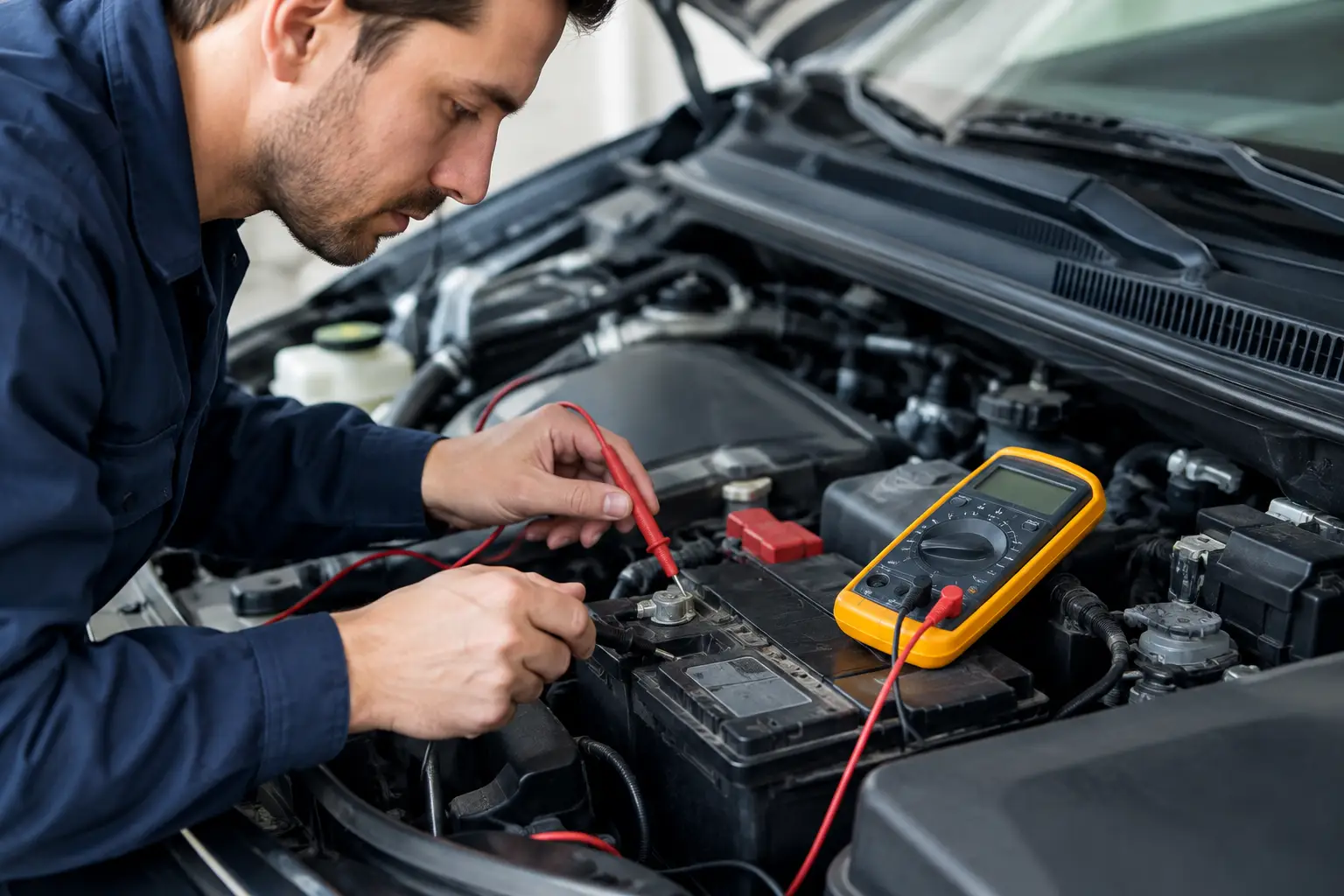
How to Diagnose Battery Drain in Your Car
A car that starts normally after a run but is flat the following morning is not simply having a bad day. Something is either using power when it should be asleep, failing to recharge the battery properly, or the battery itself can no longer hold its charge. Knowing how to diagnose battery drain helps you avoid repeated jump-starts, missed journeys and replacing parts that were never at fault.
Battery problems are more common during colder weather and on vehicles used mainly for short trips, but they can happen at any time. The key is to separate a genuine electrical drain from a weak battery or charging-system fault. Each produces similar symptoms, yet the repair can be very different.
Start by recognising the pattern
The way the fault appears provides useful clues. If the engine turns slowly after the car has been parked overnight, but starts easily once it has been jump-started or charged, the battery is losing charge while standing. If the battery warning light appears while driving, the alternator or its drive belt may be the problem instead.
A vehicle that only struggles after several days parked may have a small parasitic drain, which is a component taking more current than it should with the ignition off. A car that goes flat within a few hours usually has a more significant issue, such as an interior light staying on, a faulty module that will not enter sleep mode, or an accessory wired incorrectly.
Pay attention to changes in the car's behaviour. A clock resetting, central locking becoming intermittent, an alarm sounding unexpectedly or dashboard messages appearing after start-up can all indicate low system voltage. They do not automatically identify the cause, but they tell you the electrical system needs checking.
Rule out the obvious causes first
Before testing with equipment, inspect the battery and its surroundings in daylight. Look for loose battery terminals, white or blue-green corrosion around the clamps, damaged cables, a cracked casing or signs of fluid leakage. Corroded connections create resistance and can prevent the battery from charging properly, even when the alternator is healthy.
Also check that no lights are being left on. Courtesy lights in the cabin, boot or glovebox can be easy to miss, particularly if a switch or latch has failed. Close the doors and observe whether the interior lamps fade out as expected. A phone charger, dash camera, parking camera or aftermarket stereo can also continue drawing power after the ignition is switched off.
Do not overlook usage. Several short journeys in winter, with heated screens, blowers, headlights and seat heaters running, may use more energy than the alternator has time to replace. This is not normally a fault, but it can expose a battery that is already ageing. A proper battery charge followed by testing will show whether it has recovered.
Check battery condition and charging voltage
A battery test is the sensible first technical check. Voltage alone is not a complete diagnosis, but it gives a useful starting point. With the engine off and the vehicle left to rest, a healthy fully charged 12-volt battery will normally read around 12.6 volts. A reading close to 12.2 volts suggests it is partly discharged. Below 12 volts, it needs charging and further assessment.
Start the engine and measure again at the battery terminals. Many vehicles will show a charging voltage broadly between 13.8 and 14.7 volts, although modern smart-charging systems can vary this according to temperature, electrical demand and battery state. The exact figure depends on the vehicle, so the reading must be interpreted rather than judged in isolation.
If voltage remains low with the engine running, the alternator, belt, wiring or battery-management system may not be charging correctly. If it is excessively high, the voltage regulator may be faulty, which can damage the battery and sensitive electronic components. A professional diagnostic check is advisable in either case.
Battery age matters too. Most car batteries have a finite service life, commonly several years, but heat, repeated deep discharge, poor charging and heavy electrical demand can shorten it. A battery can show acceptable voltage immediately after charging yet fail a load or conductance test because its internal capacity has fallen. This is why replacing a battery solely on a voltage reading can be a costly guess.
How to diagnose battery drain with a parasitic draw test
Once the battery and charging system have been checked, the next step is to measure the current being drawn when the car is locked and switched off. This is known as a parasitic draw test. It is one of the most effective ways to diagnose battery drain, but it needs to be carried out carefully.
Modern cars do not switch off the moment the key is removed. Control units for the alarm, central locking, infotainment, keyless entry and other functions stay awake for a period before entering sleep mode. Depending on the vehicle, this can take anything from several minutes to well over half an hour. Testing too soon can produce a misleadingly high reading.
A technician normally connects a suitable ammeter in series with the battery, then allows the vehicle to settle without opening doors or waking modules. Many vehicles will eventually have a resting draw of roughly 20 to 50 milliamps. Some may be slightly higher due to factory-fitted security or telematics systems. What matters is whether the draw is within the manufacturer’s expected range and whether it reduces properly after the sleep period.
Avoid disconnecting and reconnecting the battery repeatedly during testing. Doing so can wake electronic modules, reset stored data or create a voltage spike. It is also easy to blow a multimeter fuse if it is connected incorrectly or used on the wrong range. For vehicles with complex electronics, a professional current clamp and diagnostic equipment provide a safer, more reliable route to an answer.
Find the circuit causing the drain
If the resting draw is too high, the task becomes locating the circuit responsible. This is not a matter of randomly replacing fuses or parts. A technician will use the vehicle’s fuse boxes, wiring information and live diagnostic data to identify which circuit reduces the draw when isolated.
Common causes include a faulty door, bonnet or boot latch switch; a relay stuck in the on position; an infotainment unit that fails to shut down; a malfunctioning alarm; or an aftermarket accessory wired to a permanent live supply. On newer cars, a control module may stay awake because it is receiving an incorrect signal from another component. That is where fault-code reading and network diagnosis become particularly valuable.
For example, a boot latch may report that the boot is open when it is physically shut. The car may keep interior systems awake to protect or monitor the vehicle, draining the battery over time. The visible symptom is a flat battery, but the real fault is the latch switch or wiring. Accurate diagnosis prevents unnecessary battery replacements.
Fleet vehicles can add further complications. Trackers, dash cameras, refrigeration equipment, auxiliary batteries and charging inverters all need to be considered. A legitimate electrical load may require a revised charging arrangement rather than a repair. The right answer depends on how the vehicle is used and how long it stands between journeys.
When to call a professional
If the battery repeatedly goes flat, the battery warning light is on, cables are hot or damaged, or the vehicle has modern stop-start and battery-management systems, arrange a proper inspection. Repeated jump-starting can mask the underlying fault and may leave you stranded when you most need the car.
A qualified mobile technician can test the battery, alternator output, voltage drop and standby current at your home or workplace, then trace the fault using diagnostic equipment. This can be particularly useful when the issue is intermittent or when getting a non-starting car to a garage would be inconvenient. Elite Vehicle Servicing supports drivers across Surrey and West Sussex with practical electrical diagnosis and repairs backed by experienced engineering support.
Until the cause is confirmed, keep unnecessary accessories unplugged and avoid relying on frequent jump-starts. A fully charged, correctly tested battery gives the diagnostic process a fair starting point - and a precise repair gives you the confidence that the next turn of the key will not be a gamble.
Comments