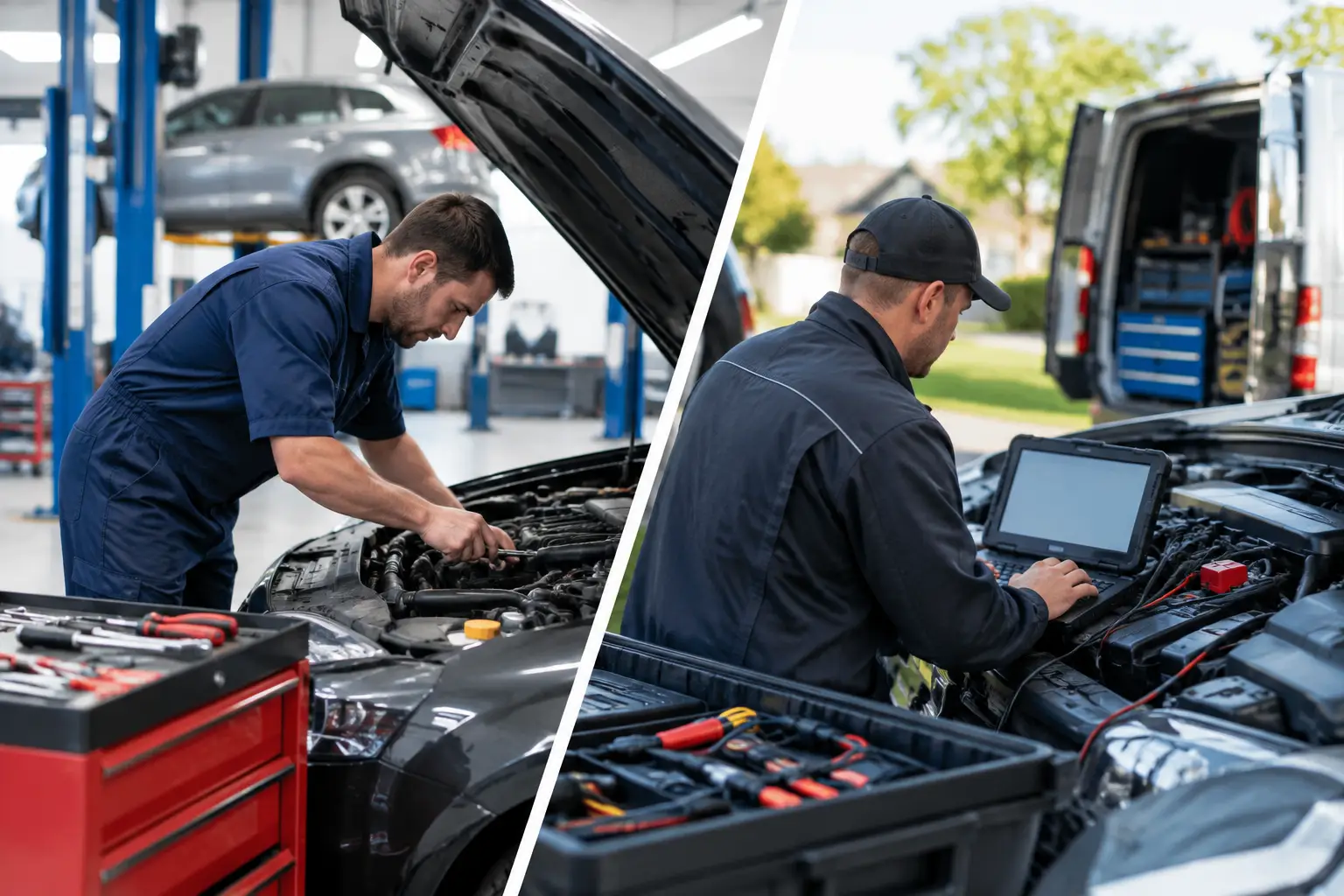
Surrey Garage Versus Mobile Repairs Compared
A failed starter outside the house, worn brake pads before the school run, or an overdue service can leave one question: Surrey garage versus mobile repairs, which is the better option? The right answer is not always the nearest garage. It depends on the fault, where the vehicle is parked, how quickly you need it back on the road, and whether the work can be completed safely where the car sits.
For many everyday repairs, a qualified mobile engineer removes the time and disruption of arranging lifts, taking time off work and waiting for a collection call. For some major faults, however, a workshop remains the sensible and safest place to work. Understanding that difference helps drivers make a decision based on value and quality, rather than convenience alone.
Surrey garage versus mobile repairs: the real difference
A traditional garage asks you to bring the vehicle to its premises. That arrangement works well when the car is driveable, the repair needs a ramp or specialist workshop equipment, or the job may require several days of dismantling and testing. It also gives the garage a controlled environment, particularly useful for complex engine or gearbox work.
Mobile repairs bring the engineer, tools and diagnostic equipment to your home, workplace or fleet site. This can be particularly useful across Surrey when a vehicle is not starting, has an electrical warning light, needs routine servicing, or cannot be taken off the road for a full day. You keep control of your time, and the engineer can often inspect the vehicle in the conditions where the problem occurs.
The distinction is not simply garage good, mobile convenient. A properly equipped mobile service can carry out a wide range of mechanical maintenance and fault-finding to a professional standard. Equally, a responsible provider will be honest when the job needs workshop facilities rather than attempting a repair in unsuitable conditions.
When mobile repairs are usually the better choice
Mobile work is most valuable when the repair is practical to complete on site and the vehicle has a safe, accessible place to be worked on. Routine servicing, battery replacement, brake repairs, wiper replacement, air-conditioning re-gassing and many diagnostic investigations can often be completed at home or work.
It is also a strong option when a car has developed a no-start issue. Rather than paying for recovery before anyone has identified the cause, a mobile engineer can test the battery, charging system, starter circuit and relevant electronic systems where the vehicle is parked. A warning light does not automatically mean a major repair. Accurate diagnostics can separate a simple sensor or wiring issue from a more serious fault.
For commuters and families, the time saving is often the deciding factor. There is no need to arrange a second driver, sit in a waiting room or use annual leave for a service. The vehicle can be maintained while you work from home, manage the household or carry on with a normal working day.
For business owners, the benefit is even clearer. A van, company car or small fleet sitting at a garage can mean missed appointments and lost earning time. Planned mobile maintenance at a depot or workplace helps keep vehicles available and gives fleet managers one point of contact for servicing, repairs and fault diagnosis.
When a garage or workshop is the right call
Some repairs need the space, lifting equipment and controlled conditions of a workshop. Extensive engine rebuilds, major transmission work, structural corrosion, alignment work and certain clutch replacements may require equipment that cannot reasonably or safely be transported to a driveway or car park.
A vehicle’s location matters too. Work should not be carried out beside fast-moving traffic, on unstable ground, in poor lighting or where there is inadequate room to lift and inspect the vehicle safely. A trustworthy mobile provider will assess this before starting. Convenience should never take priority over safe working practices or the quality of the finished repair.
There are also occasions when a vehicle needs parts removed for further inspection or the fault requires extended testing. In those cases, workshop repair may be more efficient than repeated mobile visits. The best service is one that recommends the method that gives a reliable result, not the one that sounds easiest at the outset.
Capability matters more than the location
The most common concern about mobile repair is whether an engineer can diagnose modern vehicles properly outside a garage. The answer depends on the engineer’s training and equipment, not on the postcode where the bonnet is opened.
Modern cars rely on interconnected electronic systems. A dashboard warning can relate to engine management, emissions equipment, braking systems, charging circuits, sensors or communication faults between control units. Reading a fault code is only the beginning. The real work is testing the cause, checking live data, examining wiring and confirming the repair before the vehicle is returned to use.
Ask what diagnostic equipment is used, whether the engineer is qualified for the work, and how the repair will be verified. An experienced mobile engineer should explain the findings in plain language, outline the repair needed and make clear if further workshop support is required.
This matters especially with intermittent faults. A car that occasionally loses power, struggles to start or displays a warning light after rain may not fail when it reaches a garage. On-site inspection can give the engineer useful context, including the vehicle’s parking conditions, recent use and the exact symptoms reported by the driver.
Comparing cost fairly
A garage quote and a mobile repair quote should not be compared on labour rate alone. The real cost includes your time, fuel, recovery if the vehicle is immobile, alternative transport and the potential loss of work or family commitments. For a straightforward repair, mobile servicing can offer better overall value because those hidden costs are reduced.
That said, mobile work is not automatically cheaper in every situation. A complicated job that needs several people, a ramp, specialist lifting gear or lengthy strip-down may be more cost-effective in a workshop. The important point is to receive a clear explanation of what the price covers: diagnosis, labour, parts, consumables and any follow-up testing.
Quality parts and warranty protection should be part of the conversation as well. A low initial price is poor value if the same fault returns weeks later. Elite Vehicle Servicing supports its workmanship with a 24-month warranty, giving customers confidence that repairs are intended to last, not simply get the car moving for the day.
Questions to ask before booking
Whether you choose a garage or mobile engineer, ask how the fault will be diagnosed, whether the price includes parts and VAT, and what warranty applies to the work. It is also worth asking whether the engineer can complete the repair at your location or will advise on workshop arrangements if conditions or the fault make that necessary.
For mobile visits, be ready to describe the symptoms accurately. Note when the problem started, any warning lights, unusual noises, smells, loss of performance or recent work carried out. If the car will not start, say whether the dashboard lights come on and whether you hear clicking, cranking or nothing at all. Those details help the engineer arrive prepared.
Provide a level, accessible parking space where possible, and let the provider know about height restrictions, gated access or underground parking. A few minutes of information before the appointment can prevent delays and help ensure the repair is completed in one visit.
A practical choice for Surrey drivers
For routine maintenance, common mechanical repairs and advanced diagnostics, mobile servicing can be a practical alternative to losing a day at a garage. It is particularly useful when a vehicle is stranded at home, when work schedules are tight, or when several fleet vehicles need attention in one place.
For major repairs or jobs requiring specialist workshop equipment, a garage remains the right setting. The key is choosing a provider with the judgement to recognise the difference and the technical ability to support you either way.
If your car has developed a fault, start with the symptoms rather than assuming the repair route. A clear diagnosis, a safe working location and an engineer prepared to recommend the right solution will do more to keep you moving than a garage booking or mobile visit chosen on convenience alone.
Comments